Thursday, August 22, 2013

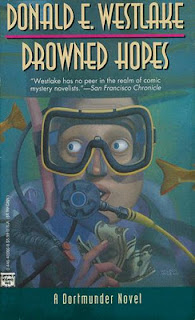
Drowned Hopes by Donald Westlake


Well, John Dortmunder is certainly over his head in Drowned Hopes by Donald Westlake.

This is the seventh in the series of comic capers starring the unlucky professional burglar and his gang of crazy colleagues. Mr. Westlake has created a most elaborate and complicated puzzle for Dortmunder to solve. 

A former cellmate of John's, Tom Jimson, shows up at John's apartment having just been released from prison. With a promise to split the loot, he enlists John's aid in recovering a cache of $700,000 - the proceeds of an armored car robbery - that, before he went to prison, he had buried in a casket behind the library in Putkin's Corners in upstate New York.

Sounds simple, right? Only trouble is that while Tom was in prison, the town and surrounding area was commandeered by the state and flooded to create a reservoir. So now, not only is the money buried underground, it is also 50 feet under water.

Oh my. Does Mr. Westlake have fun with this one! 

Along with the usual gang members Andy Kelp, Stan Murch, Tiny, May, and Murch's Mom, the characters include:

Seventy-year old, cold as steel Tom Jimson, whose favored way of solving any problem is "Kill 'em!"; Wally, the reclusive geek who plays fantasy save-the-princess type games on his computer; town librarian Myrtle Street who lives on Myrtle Street with her mother Edna in the town near the reservoir; Guffey, a former partner of Tom Jimson's who has lived alone so long he has forgotten his own first name; and, Doug, dive shop owner and wooer of the fair Myrtle.

Usually the action in these fun books takes place in New York City, but now the group has moved to Dudson Falls near the reservoir and Dortmunder and Tom make trips to Oklahoma and South Dakota to retrieve cash for the caper that Tom has stashed there. 

Somehow Mr. Westlake manages to work in to all this a ghost town, an alien spaceship sighting, Raquel Welch movies, a shotgun wedding, the QEII, the left nostril of Abraham Lincoln, and the usual bounty of stolen cars with MD license plates.

Mr. Westlake can twist a plot faster than you can say "Dortmunder". He leaves me laughing all the way. 

Wednesday, August 21, 2013

Stash at the Library


I definitely need to get to the library today. I have two books on hold (why do they all seem to become available at the same time?) and the DVD of the HBO miniseries John Adams that is overdue and costing me the huge sum of twenty-five cents a day in fines! 

The first book waiting for me is The Seventh Sinner by Elizabeth Peters, author of the Amelia Peabody series about the 19th century archaeologist and detective.  In this new-to-me series, the amateur sleuth is Jacqueline Kirby, former librarian turned best-selling author. The action in this one takes place in twentieth century Rome. 

The second book on hold is The Real Jane Austen: A Life in Small Things by Paula Byrne that I am looking forward to reading...this being the year of Our Jane and all.

I also have a copy of Killer in Crinolines by Duffy Brown that I picked up last week. I met Ms. Brown at the Kentucky Book Fair last November when I bought her pleasant mystery Iced Chiffon. This book continues the sleuthing adventures of Reagan Summerside in Savannah.

I'm off!

Tuesday, August 20, 2013

In Which David Foster Wallace Visits the State Fair


It is State Fair time in America and instead of actually going out amongst the people, the animals, the crazy food, I decided I would armchair the event by reading David Foster Wallace's report on the 1993 Illinois State Fair which is included in the collection A Supposedly Fun Thing I'll Never Do Again.

Written a few years before he took and reported on the luxury cruise (here), also for Harper's magazine, it has Wallace's same breathless style of reporting, same attention to details of smells and sounds, same admissions of his own fears and phobias, and same hilarious mocking tone of the people and their activities. 

Wallace grew up in small-town Illinois, so his mocking comes from a place of semi-affection, not what he calls East Coast elitism. He visits swine, beef and sheep stalls (but not the poultry pens as he was once attacked by a crazy hen); eats all the artery-clogging food that is available especially the home-made desserts; finds he is especially enthralled with the baton twirling competition and the clogging dance competition; only visits the midway to report on what horrors it holds (vomit-inducing rides and pot-smoking carnies) but refuses to put himself in any danger; and wanders around the exhibit hall in awe of the goings on there - endless ThighMaster demonstrations, window replacement come-ons, and t-shirts sporting vaguely obscene slogans.

Here is a peek from his Getting Away From Already Pretty Much Being Away From It All:

The (Press) Briefing is dull. We are less addressed than rhetorically bludgeoned by Fair personnel, product spokespeople, and middle-management State politicos. The words, excited,  proud and opportunity are used a total of 76 times before I get distracted off the count. I've suddenly figured out that all the older ladies I'm at the table with have confused Harper's with Harper's Bazaar. They think I'm some sort of food writer or recipe scout, here to maybe vault some of the Midwestern food competition winners into the homemaker's big time. Ms. Illinois State Fair, tiara bolted to the tallest coiffure I've ever seen (bun atop bun, multiple layers, a veritable wedding cake of hair), is proudly excited to have the opportunity to present two corporate guys, dead-eyed and sweating freely in suits, who in turn report the excited pride of McDonald's and Wal-Mart at having the opportunity to be this year's Fair's major corporate sponsors. It occurs to me that if I allow the Harper's Bazaar-food-scout misunderstanding to persist and circulate I can eventually show up at the Dessert Competition tents with my Press Credentials and they'll feed me free prize-winning desserts until I have to be carried off on a gurney. Older ladies in the Midwest can bake.

Monday, August 19, 2013

So Big by Edna Ferber


Might I suggest that you close the book/books you are reading, return the books you just checked out from the library, ignore your ToBeRead list, and forget the piles of books by your bedside, your reading chair, and on your kitchen table.

My recommendation is that you find a copy of So Big by Edna Ferber and read it right now. It is the Great American Novel. Don't worry if you aren't an American because the tale of Selina Peake is universal. It just happens to take place in and near Chicago in the years just before and after the turn of the twentieth century.

I wouldn't dare give away any of the plot. I will tell you that Ms. Peake is an adventurous soul who is up for anything life has to send her way. She is a sparkling, glittering personality who finds herself in the mud and the poverty of a small truck-farming community south of Chicago. And still she continues to shine. She is a woman who finds beauty in the green and purple cabbages growing in the fields. How she manages to combine her love of beauty and the backbreaking, heartbreaking toil that comes with life on a small, uncompromising plot of land is the tale. 

Ms. Ferber has a lot to say in this novel that won the Pulitzer Prize in 1925. She writes about fertilizer and friendship; poverty and prosperity; asparagus and art; city life and country life; architecture and authenticity; dreams and despair. 

And hands. Ms. Ferber is fascinated with hands. She often refers to the rough, gnarled, scarred hands of the farmers and the soft, white, useless hands of the wealthy. (Guess which ones she admires the most.)

I really can't say enough about this book. I was surprised at how much I enjoyed it, thinking it would be outdated and fussy. It is anything but. I sometimes grow weary of characters in novels, but I never tired of Selina, the people in her life, and Ms. Ferber's look at the American culture of a century ago.

Highly, highly recommended. It will go on my list of favorite books to be reread and enjoyed. I hope it will go on yours.

Sunday, August 18, 2013

The Belly and the Members


At the end of The Junior Classics Volume I (Fairy and Wonder Tales), fifteen pages are devoted to a collection of Aesop's Fables. Most of us will have learned lessons from  'The Tortoise and the Hare', 'The Fox and the Grapes', and 'The Ant and the Grasshopper'. Here is what the introduction has to say about the stories and a little gem that I found among them - a bit of an anatomy lesson.


Aesop's Fables has come to be the commonly accepted name for the well-known collection of stories about animals, though we cannot be sure that any of them were written by the Greek slave of that name, who, Herodotus tells us, lived about the year 550 B.C. The fable about animals is probably the oldest form of story known. Its object is to teach a lesson to men and women, without seeming to do so, and because of this concealed lesson it has always been a great favorite with all nations.

The Belly and The Members

One fine day it occurred to the Members of the Body that they were doing all the work and the Belly was having all the food. So they held a meeting, and after a long discussion, decided to strike work till the Belly consented to take its proper share of the work. So for a day or two the Hands refused to take the food, the Mouth refused to receive it, and the Teeth had no work to do. But after a day or two the Members began to find that they themselves were not in a very active condition; the Hands could hardly move, and the Mouth was all parched and dry, while the Legs were unable to support the rest. So thus they found that even the Belly in its dull quiet way was doing necessary work for the Body, and that all must work together or the Body will go to pieces.

Saturday, August 17, 2013

The Young Folks' Shelf of Books

The Junior Classics: The Young Folks' Shelf of Books

So as not to let the adults have all the fun with The Harvard Classics, in 1912 Collier's published a set of ten volumes for children entitled The Junior Classics: The Young Folks' Shelf of Books. It doesn't take up a 'five-foot shelf ' as the books for the older readers, but the books are filled with fairy tales and folk tales, the adventures of heroes and heroines, animal and nature stories, and an entire volume of poetry.

This is from the introduction to the junior set written by Dr. Charles W. Eliot, he of Harvard: 

The purpose of The Junior Classics is to provide, in ten volumes containing about five thousand pages, a classified collection of tales, stories, and poems, both ancient and modern, suitable for boys and girls of from six to sixteen years of age. Thoughtful parents and teachers, who realize the evils of indiscriminate reading on the part of children, will appreciate the educational value of such a collection. A child's taste in reading is formed, as a rule, in the first ten or twelve years of its life, and experience has shown that the childish mind will prefer good literature to any other, if access to it is made easy, and will develop far better on literature of proved merit than on trivial or transitory material.

My set, with its dark maroon bindings, came to me from someone in my family.  It was published in 1912 and I am only missing two of the volumes: III (Stories from Greece and Rome) and V (Stories That Never Grow Old). Not bad for a collection that is 100 years old!

There is a Reading Guide in Volume X that gives a list of Best Books to read as further investigation into the type of stories that each volume contains. That is very helpful.

There is an Index of Authors and an Index of Titles as well as a breakdown by school grade of the works appropriate for those ages. Each volume has illustrations which add to the charm.

Among the authors are Aesop, Louisa M. Alcott, Washington Irving, Beatrix Potter, Sir Walter Scott, and William Shakespeare. Titles include The Ugly Duckling, The Sword of Excalibur, O Captain! My Captain! and, A Visit From St. Nicholas. This last selection was bookmarked with a wide red ribbon. A popular choice apparently.

Because my childhood reading was pretty much what Dr. Eliot warns against - "trivial and transitory" - I most likely would benefit from reading some of the selections in The Junior Classics. And even though the pages are a bit musty smelling, the ideas and words and principles they contain continue to be pure and fragrant.

Friday, August 16, 2013

The Five Foot Shelf

Fifty-one volumes: Harvard Classics
In a turn of conversation with The Professor the other day, the Harvard Classics were touched upon. I did a bit of sleuthing about that venerable series and found that the 51-volume anthology of classic works was originally published by Colliers in 1909.

It was known as Dr. Eliot's Five Foot Shelf, as Charles W. Eliot, then president of Harvard, was the unwitting instigator of the project claiming that, according to Wikipedia,  "the elements of a good liberal education could be obtained by spending 15 minutes a day reading from a collection of books that could fit on a five-foot shelf."

There is everything here from autobiography to Greek drama to essays to fiction and poetry. A fine education indeed.

Today, one can actually access the writings online at Project Gutenberg (here) although that would not be quite as satisfying as sitting down with the actual books and browsing through them reading a bit here and there. 

I also discovered that Christopher Beha wrote an account of a year spent reading all 51 volumes in The Whole Five Feet: What the Great Books Taught Me About Life, Death, and Pretty Much Everything Else (2009). It is now on my TBR list.

That project reminds me of the wonderfully funny book The Know-It-All: One Man's Humble Quest to Become the Smartest Person in the World by A.J. Jacobs about his year spent reading the Encyclopedia Britannica from A to Z.

I don't have the Harvard Classics but I feel as if someone, somewhere in my family did. I do have an incomplete set of Collier's Junior Classics: The Young Folks' Shelf of Books from 1912 that I will write about another time. Book One contains an introduction to the anthology by Dr. "Five-Foot Shelf" Eliot himself.

One can buy sets of the Harvard Classics online and I have seen them at used books stores. Or you might be lucky and find a set at a yard sale or estate sale. Or perhaps you already own your own Five Foot Shelf. If so, I would like to hear about it. How many of the volumes have you read?