Although I have become a convert to the joys of my library's ebook collection, there is still something to be said for actually visiting the library.
It was on such a day - the salt truck and snow plow crews had done an excellent job of removing evidence of our recent two snowfalls - and I was on a mission to pick up a book I had reserved from the main library.
Because I can't just walk up to the circulation desk, retrieve my book and leave, I spent some time wandering about the spacious lobby that holds shelves of new fiction and nonfiction books, displays of Recommended by Our Librarians, and seasonal or subject-specific exhibits.
And so I stumbled upon The Pleasure of Reading: 43 Writers on the Discovery of Reading and the Books that Inspired Them.
Edited by Antonia Fraser this book about books was originally published in 1992 in commemoration of bookseller WHSmith's bicentenary and reissued in 2015 by Bloomsbury in aid of the Give a Book charity.
It has been on one of my many Books to Be Read lists. The library has never had available the 1992 edition and only put this copy into circulation on October 21, 2015. (I find it so useful that some scribe at the library stamps the date that a book goes on the shelf on its top edge.)
The writers were asked to describe their early reading, what books or authors influenced them, and what they enjoyed reading today. At the end of every entry, the writer lists ten or so of his or her favorite books.
There is a section with biographical information about the authors at the back of the book. These are listed in the order that the essays appear and the essays are in chronological order by author's year of birth. There is a wonderful range from Stephen Spender (1909) to Tom Wells (1985). In between we have Patrick Leigh Fermor, Jan Morris, Ruth Rendell, Edna O'Brien, Tom Stoppard, Sue Townsend, and, oh, so many others.
I get a warm feeling of familiarity when an author mentions a book I know and love. Oh, yes, I have read and also hold dear that book! It is the same feeling I get when I watch a movie and I recognize a street or a cafe or building in a city that I have visited. Oh, yes, I have been there!
On the other hand, books are mentioned that I used to own and have given away and now wish that they were still on my shelves so that I could revisit them. The dilemma of a book lover with limited space.
*********************
In other breaking news, I have added a gadget to the top right of Belle, Book, and Candle that lets you enter your email address and then somehow you will be notified when a new post is published. I now feel very tech savvy! I hope this works. You will have to let me know.
I do like reading a book about books, although the books mentioned in this one won't be found on your library's shelf. Too bad. Disturber of the Peace and its followup The Pen Is Mightier...would be a delight to read. Both are the work of the fictional Miss Barbara Buncle.
If you are not familiar with D.E. Stevenson's Miss Buncle's Book, the story revolves around our heroine, who due to the dwindling of her monthly dividends, decides to write a novel featuring the folks in her small English village of Silverstream. She writes under the pseudonym of John Smith and to the horror of her neighbors her fictional characters are all too recognizable.
There are the usual village personalities: the snooty Mrs. Featherstone Hogg; the bully Mr. Bulmer; the confirmed bachelor Colonel Weatherhead; the overworked, kindly doctor; the vicar with a secret; and, the gold-digger Vivian Greensleeves.
Mr. Abbott, the London publisher of what turns out to be a bestseller, is quite taken with Miss Buncle and kindly steers her through the choppy waters of being a first-time author.
In the meantime, the villagers led by Mrs. Featherstone Hogg are on a mission to identify and 'horsewhip' John Smith never suspecting that the timid, frumpy Barbara Buncle is the woman whose words have brought on so much trouble.
As the residents read about themselves, or at least Miss Buncle's keen observations about them, changes start to happen. The bully becomes more considerate of his wife and children and the confirmed bachelor begins to notice the charms of his neighbor.
Even Miss Buncle begins to take on the assertive and more glamorous aspects of Elizabeth Wade, her alter ego and narrator of the books.
There is a second Miss Buncle book that I already have on reserve at the library. If you are a fan of such gems as Cranford and Lark Rise to Candleford, you will feel right at home with Miss Buncle and her neighbors.
This morning I read a New York Times interview with one of my favorite authors Bill Bryson. The Q&A was in the newspaper's By The Book feature (here). As you might imagine the interviewees answer questions about what they are reading, what authors have influenced them, and other bookish inquiries. Past authors have included Sue Grafton, Simon Winchester, and David McCullough plus many many more. (Where have I been that I am just now discovering this column?)
Anyway, as I have no book to report on at this minute, I thought I would interview myself based on the Bryson interview. (I hope that I am not breaking any copyright laws by doing so!)
What books are currently on your nightstand?
I am reading on my Kindle Losing Ground by Catherine Aird and I have a paperback edition of The Egg and I by Betty MacDonald that is gathering dust as it has been there for so long.
What's the last great book you read?
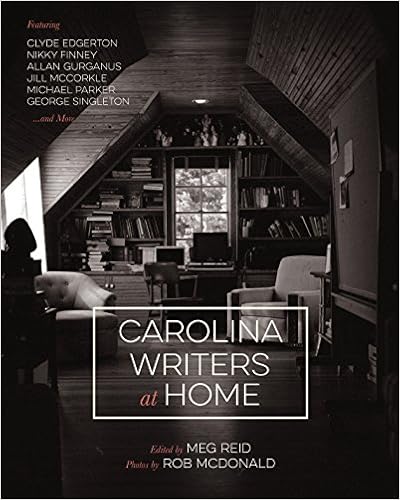
Carolina Writers at Home is tremendous. A collection of essays by many authors I was not familiar with. And it has these wonderful brooding, sepia-toned photographs.
Which writers, poets, journalists working today do you admire most?
Alexander McCall Smith, Bill Bryson, Mary Oliver, Billy Collins,
Anne Fadiman, Alain de Botton, Michael Dirda, Annie Dillard.
Who are your favorite travel writers and what is your favorite travel book?
Bill Bryson certainly comes to mind. I am sure I would get along with Patrick Leigh Fermor although I have yet to get my hands on any of his books.
Which genres do you especially enjoy reading?
Mystery, vintage children's books (because my own childhood reading was somehow neglected), the humor of Dave Barry and James Thurber. Books about books.
Which do you avoid?
Anything too violent, romance novels, science fiction, pretentious literary fiction.
What was the last book that made you cry?
The Woman Who Walked in Sunshine by Alexander McCall Smith. Not that it was sad, but his characters are so touching.
The last book that made you laugh?
Drop Dead Healthy by A.J. Jacobs. He always makes me laugh.
The last book that made you furious?
Everyone is Entitled to My Opinion by David Brinkley. A lesson in how American political shenanigans never change.
Favorite poems?
"Wild Geese" by Mary Oliver. "Forgetfulness" by Billy Collins. Together these two poems could save the world.
Your favorite movie adaption of a book?
To Kill a Mockingbird. I am also very fond of the television productions of Lark Rise to Candleford and Cranford.
Who is your favorite fictional heroine or hero?
I must say that I adore Mma Precious Ramostwe and I hope that somewhere in the world there lives a woman just like her. And of course Nancy Drew set me off to a lifetime of reading mysteries. And I mustn't leave out brave Scout Finch from To Kill a Mockingbird.
Your favorite anti-hero or villian?
Well, I wouldn't call him a favorite, but I sure wouldn't want to meet Oliver Twist's bully Bill Sikes in a dark alley.
What kind of reader were you as a child?
I was slow to enter the world of books. My second grade teacher sent home a note to my parents that I needed to read more for enjoyment. She would be so proud now!
What childhood books or authors stick with you most?
The Nancy Drew mysteries and the tales of Mary Stewart and Daphne duMaurier. Also, Caddie Woodlawn by Carol Ryrie Brink. As an adult I discovered Ms. Brink's The Pink Motel and was swept away by it.
If you had to name one book that made you what you are today, what would it be?
Travels With Charley by John Steinbeck. I read it when I was a junior in high school and it made me want to become a writer. And I did.
What author, living or dead, would you most like to meet?
I can't pick just one: E.B. White for his words, Agatha Christie for her plots, and P.G. Wodehouse for his characters.
What was the last book you put down without finishing?
Skippy Dies by Paul Murray and Little Face by Sophie Hannah. The titles both showed up recently on a list of mysteries to read but I couldn't get into either one.
Of the books you've written, which is your favorite?
Well, unlike Mr. Bryson, I haven't written any books but as for my over 800 blog posts I would have to choose the ones about my literary adventures (The Grand Southern Literary Tours, One and Two) and my accounts of meeting various authors.
Whom would you like to write your life story?
Bill Bryson. He would be able to take the jumble of my journals and turn them into a humorous tale.
I am not really sure how to classify The Dead Ladies Project. It is part travelogue, part biography, part memoir. It begins with the author Jessa Crispin standing in her Chicago kitchen trying to convince two policemen that she is not going to kill herself.
She realizes it is not her physical life that needs to end but only what she was doing with it. She divests herself of her apartment, her furniture, her books, her men, and her social circle and heads off to Europe. Her aim:
It was the dead I wanted to talk to. The writers and artists and composers who kept me company in the late hours of the night: I needed to know how they did it. I'd always been attracted to the unloosed, the wandering souls who were willing to scrape their lives clean and start again elsewhere. I needed to know how they did it, how they survived it.
So begins her two year journey. But not all the Dead Ladies are Ladies. First, she visits the William James Center which turns out to be just a small room at the University of Potsdam near Berlin where James had come to escape the heavy hand of his father. She spends time reading his letters, journals, and essays in order to absorb his pragmatic philosophies.
In Trieste, she ponders what Nora Barnacle felt as she waited all that first night in the city for her soon-to-be husband James Joyce to return to where he had left her and their luggage outside the train station.
She visits St. Petersburg where W. Somerset Maugham goes to escape his scolding lover Syrie. In Lausanne she marvels at how Igor Stravinsky and his music seemed to thrive even as he faced limitations during the war.
And so she moves on to Maud Gonne's Galway, Rebecca West's Sarajevo, Margaret Anderson's South of France, Jean Rhys's London, and Claude Cahun's Jersey Island.
It is a dizzying journey.
But this is not a lilting, carefree trip from four-star hotel to four-star hotel. Ms. Crispin sublets not-so-nice apartments from sometimes not-so-nice landlords. She occasionally stays with or meets with friends. She drinks. A lot. And often. She cries in airports. She gets lost. She pines for the married lover she left behind. She struggles with unfamiliar languages and streets and people.
She doesn't seem to be having a good time.
Her depression, or maybe it is just melancholy, is contagious. It set up a wanderlust in me that spiraled into thoughts of selling everything and moving about America spending a few days here or a few weeks there until money or time ran out.
I enjoyed reading about the lives of these artists and writers. I enjoyed reading her impressions of the cities she stays in. I enjoyed her writing style and her intelligence. I enjoyed reading about her choice to at least try and create a different life for herself. If you can get past her youthful romantic yearnings and louche lifestyle, I think you would enjoy this book too.
I received two books for Christmas which always makes for a happy occasion. I asked for Carolina Writers at Home edited by Meg Reid. I have strong connections with both North and South Carolina and I love reading about writers and where they work. This one seems to have a nice spin on it as the authors were asked to write anything at all about their homes from any perspective they felt was important. So they are not all well-crafted essays about wooden desks and bookshelves. The variety is splendid. For example, Clyde Edgerton writes about the fireplace and backyard fire pit at his home in Wilmington.
The photos by Rob McDonald are sepia toned which gives all the interiors and the portraits of the contributors a soft look. I didn't like that at first but now I think it is perfect.
The other book was a surprise: The Little Paris Bookshop by Nina George. I know nothing about this novel, but Paris and Bookshop! What's not to like? I haven't started reading it yet, but it is right here by my chair.
Thanks to all of you who read my musings and commented here on Belle, Book, and Candle this past year. I feel as if we are all friends and I look forward to continuing our bookish conversations.
Wishing you a Happy New Year full of Good Books, Good Friends, and Good Health.
I have barely read any book reviews in the media this past year and all those lists being published right now about the Best Books of 2015 have left me cold. I have not added to a written To Be Read List. All year I have been overwhelmed with choice: the public library shelves, my own library, books on my Kindle, the library's ebook collection, used book sales...
The plan I have followed is that if a book shows up on my radar and piques my interest, and if I can get my hands on it, I read it. This is how I came to be reading The Folded Clock: A Diary by Heidi Julavits.
The title had me at Clock and Diary.
An image of a folded clock came to mind. It was the little travel clock that my father had. It was in a hard leather case that opened and revealed a clock face. The case and the clock formed its own freestanding triangle and would fit snugly on a bedside table. The clock had to be wound up with its little key on the back. It ticked. I loved it.
But this book is not about clocks, although it does concern time. It is, as the subtitle claims, a diary...of sorts. And I love reading diaries. Each dated entry - month and day only - begins with the word "Today..." The events take place over two years' time and they are not sorted chronologically. This actually makes for interesting reading. One minute the reader is in New York City on 9/11 and the next celebrating a Fourth of July holiday in Maine. A few pages later and there is the account of a dinner for academics attended by the author and her husband in Germany.
The accounts of the events in those two years are sometimes entertaining but sometimes her riffs spawned by the events are over-the-top neurotic. She seems to know a lot of people - other writers, film directors. She doesn't name drop but teases the reader with I-know-this-famous-person-but-I-am-not-going-to-tell-you-who-he/she-is. I found that annoying. Not because I don't want to miss out on celebrity gossip, but it seemed smug.
I have to tell you that although I am enjoying many of the stories that Ms. Julavits writes - her visit to E.B. White's grave; her attempts to read the French journals of the gossipy Goncourt brothers; her attendance at a party at Edith Wharton's house - I decided about a fourth of the way in that I didn't really like her.
I looked up her photo online thinking that might change my feelings toward her. It didn't.
I suppose that when reading someone's published diary, it is key to liking the diarist! Think E.M. Delafield (Diary of a Provincial Lady) or Virginia Woolf (A Writer's Diary).
I have been torn between wanting to let the book go because I don't care for the author or to continue reading it because some of the events that take place intrigue me.
The Folded Clock is on my Kindle as an ebook from the library and will expire in four more days. I guess I will let it.
Has this happened to you? You enjoy the book but wouldn't want to have coffee with the author? I would love to hear if you have had a similar experience.
I came across an excerpt from The Declutter Code: 10 Simple Steps to Clarity right before I was getting ready to head off on my retreat at the Abbey of Gethsemani. I liked what author Yvette Bowlin had to say about outside clutter being a sign of inside clutter and discovered her ebook was available on Amazon for 99 cents.
As the only screen I took with me to the monastery was my Kindle, I figured this would be a perfect opportunity to read a little deeper into Ms. Bowlin's steps to clarity.
No clutter here. The book runs a mere 138 pages but packs in a lot of information. This is not a how-to-clean-your-closets book. You won't find directions for ditching your desk debris or a blueprint for banishing your baking tins.
Ms. Bowlin believes that our environmental clutter is a result of our cluttered minds and that is the mess she intends to clean up.
In Part One, The Truth About Clutter, she looks at our "overcrowded, overloaded and overwhelmed minds." Too much noise along with too many ToDo lists, phone calls, errands, emails, texts, and endless news alerts. We are constantly frazzled and dazzled.
It's no wonder our closets are stuffed, our kitchen cabinets are clogged, and we can't find our car keys.
I admit I sort of rushed through Part One as I know what the problem is. I wanted to get on to the solution.
In Part Two, Clearing Clutter, she offers that solution. Ah. Take a deep breath. Feel your mind relaxing and your thoughts clearing...just a bit. Clarity, as she defines it, is "freedom from anxiety and overwhelm. It is freedom from overthinking, overload and overcompensation. A clear mind is a peaceful mind."
Her 10 Steps to Clarity, which she developed from her own experiences in clearing her cluttered life, I found to be practical and easy to follow. She suggests concentrating on each step for one week. Each step builds off the one before. There is no rush.
In each chapter she gives a short explanation of the step, how it clears mental clutter, what it feels like, and a tool or tools for implementing the step. Finally she offers up an experiment - three or four suggestions to try out for yourself and make note of the outcomes.
Since her Step One is Slow, Step Two is Still, and Step Three is Silence, being on retreat allowed me to really immerse myself in all of those. I could feel my mind slowing down and could actually grab hold of a thought or two as they went swirling by. I had nowhere to be and purposely slowed my walking pace and didn't hurry through my meals. There were plenty of opportunities and quiet places to be still and silent at the monastery and I took advantage of them.
But guess what. Now I am back into the Race and Rush of Life. I am no longer on the monastery's time of slow, still, and silence. I have not read Step Four which is Space. I have not read ahead to the rest of the steps: See, Shift, Simplify, Savor, Sort, and Sleep. (OK, maybe I am already practicing that last one!)
I think it would be helpful for me to go ahead and read through the rest of the steps. To get an idea of the big picture. Then I can start over and implement her suggestions. I really do want to know what she has to say, so I won't give up.
If you are looking for a little peace and serenity - and who isn't - this well-written book offers some workable suggestions on how to bring some clarity into your life.
Now, breathe...