Showing posts with label Golden Age Classic Mysteries. Show all posts

Friday, February 3, 2017

In Which I Finally Meet Miss Maud Silver

Image result for grey mask book

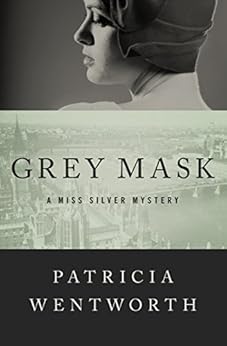
I recently made the acquaintance of Miss Maud Silver, the private investigator in the mystery series by Patricia Wentworth. My library suddenly has the books in the series on its ebook shelf. 

Grey Mask, published in 1928, is the first. The plot is pretty familiar and at times a bit complicated. There is an heiress who might not be a legitimate heiress but a shadowy group of people are out to 'remove' her. This criminal group has members that it has blackmailed into doing its evil deeds and everyone goes by a number instead of a name. A few characters take on an alias to protect their identity. There is the tattered romance between the main character Charles Moray and Margaret Langton. From the beginning we know that Margaret is part of the secret organization but we don't know why...yet. 

There are many characters and much of the action turns on coincidence and chance meetings and overheard conversations. There is a hint, too, that a character who is supposed to be dead is alive. I am about halfway through the book and trust that all will eventually be revealed.

Miss Silver doesn't make an appearance until well into the story. She is a retired governess and teacher. She knits. I suppose it helps her think. She is not at all like Miss Marple (Miss Silver came first) in that she is a professional detective and has an office in London. I suppose she gets paid although that is never mentioned. It also doesn't mention if she has employees but she seems to find out a lot of information by following people on her own.

Here is how she is introduced in her office:

...a small, light, room, very bare - furnished to the first glance at any rate, by a chair, a writing-table and Miss Silver herself.
The writing-table was immense, of the large old-fashioned flat kind with drawers all round it; the top was piled high with exercise-books of different colours very neatly stacked.
Miss Silver sat in front of a pad of pink blotting-paper. She was a little person with no features, no complexion, and a great deal of tidy mouse-coloured hair done in a large bun at the back of her head. She inclined her head slightly, but did not offer to shake hands.

It feels as if Ms. Wentworth threw every sort of mystery scenario into this first book. That said, I do find myself enjoying the tale even though the character around which the mystery revolves - the 'maybe' heiress - is quite annoying. She babbles constantly and that gets her in lots of trouble and wreaks havoc with the lives of the people trying to help her. She spends much of her time eating chocolates and writing letters to a school friend. (I can't really fault her for either of those last two things!)

I find it difficult to believe that it has taken me so long to begin to read the Miss Silver mysteries. I am glad that they are available to me as ebooks. My Kindle is so much easier to hold for reading in bed at night. Best of all, there is nothing in these easy-going mysteries to give me nightmares. 

Friday, June 10, 2016

The Middle of Things by J.S. Fletcher and A Tribute to Muhammad Ali


I am in the middle of reading The Middle of Things which seems to be a perfect place to stop and share with you what I know about this mystery novel and its author. 

The Middle of Things was written by J.S. Fletcher (1863-1935) and first published in 1922. Wikipedia's profile on Mr. Fletcher notes that he wrote 230 books of fiction and nonfiction. He started out as a journalist, moved on to writing poetry and historical fiction, and then settled down in 1914 and wrote what was to be the first of over 100 mystery novels. He was one of the leading writers of detective fiction in The Golden Age.

This tale begins in the library of the London home of Richard Viner ("a young gentleman of means and leisure") and his aunt Miss Bethia Penkridge. She is a notable fan of mystery fiction. Their evening's entertainment usually consists of her nephew reading aloud three chapters from the latest mystery novel. 


What she loved was a story which began with crime and ended with a detection - a story which kept you wondering who did it, how it was done, and when the doing was going to be laid bare to the light of day. Nothing pleased her better than to go to bed with a brain titivated with the mysteries of the last three chapters; nothing gave  her such infinite delight as to find, when the final pages were turned, that all her own theories were wrong, and that the real criminal was somebody quite other than the person she had fancied. 

Viner gently scoffs at his aunt's taste in the sensational and questions if such books are relevant to real life. She assures him that real-life mysteries abound. Sure enough, he soon finds himself in the middle of one when later that evening he goes out for a stroll and comes across the dead body of a man in the dark passage off Markendale Square.

The chase is on from there and clues and leads and more mysteries follow one behind the other. Quite fun.

I must say that I am delighted to have discovered Mr. Fletcher. His writing is clean and crisp with a soupçon of humor. He doesn't rehash and belabor clues (as some mystery writers tend to do) and the action moves along briskly.  

One odd thing is his naming of characters. Consider monikers such as Portlethwaite, Methley, Woodlesford, Perkwite, Felpham, and Millington-Baywater. Those don't exactly roll easily off the tongue.

My library has eight more of Mr. Fletcher's detective stories in its ebook collection so I have many tales to look forward to.

And that is what I am in the middle of. How about you?


*****************************
Image result for muhammad ali
Muhammad Ali
1942-2016

Today the world came to my hometown of Louisville -  a hometown that I share with Muhammad Ali who died last week at the age of 74. 

His funeral procession through the streets of the city and his memorial service today attracted thousands of people from all over who came to say farewell to this Olympic gold medal winner, three-time heavyweight world boxing champion, activist, and humanitarian. 

Ali was brash and beautiful, controversial and captivating, impassioned and inspiring.   He was known as The Louisville Lip for his predictions, pronouncements, and outrageous poetry. He had a way with words and a way with people. He had a big smile and an even bigger heart. 

Because of the Louisville connection, Ali was someone I was always aware of. I knew about The Champ's many victories in the ring and his accomplishments after he hung up the boxing gloves. I am heartened - and truth be told, quite overwhelmed - to see the outpouring of affection and respect that has been shown him this past week. He was quite a remarkable man who will be remembered for much more than just his knockout punch. 

Friday, May 22, 2015

The Golden Age Classic Mysteries

Lurid Cover!

Here is a report on the first two classes of the History of Mystery course I am taking at the library. The free, six-week course is taught by a woman with a great sense of humor and a wealth of knowledge and many reading lists. We love reading lists.

The first 90-minute session began with a brief summing up of the beginning of the mystery genre with Edgar Alan Poe's stories featuring Detective Dupin (1841), Dicken's Bleak House featuring Inspector Bucket (1852), and Sir Arthur Conan Doyle's inimitable Sherlock Holmes (1887). The instructor then gave an overview of the five types of mysteries we will be studying and a few authors in each category. 

The Golden Age: Christie, Sayers, Ngaio Marsh, Allingham
Hardboiled Detectives/Police Procedurals: Spillane, Chandler, Paretsky, Rankin
Cozy: Dorothy Cannell, Carolyn Hart, Diane Mott Davidson
Katherine Hall Page
Dark and Dangerous: Elizabeth George, Val McDermid, Tana French, Patricia Cornwell
More Than Just Mysteries: Ruth Rendell, Amanda Cross, Martha Grimes, Louise Penny

She admitted that she was introduced to detective fiction as a teenager when she found a box of mysteries in her grandmother's attic 'with lurid covers'. You know the ones she means. She eventually discovered Agatha Christie, read all of those she could get her hands on, and because she decided that Ms. Christie was the best, she didn't read another mystery for thirty years!

She is making up for lost time. 

For last night's session we were to read Ms. Christie's And Then There Were None (which I read in 2012 and wrote about here). It was such a puzzler that even though I thought I remembered how the author worked it out, I wasn't really quite sure as I was rereading the tale. I was as surprised at the ending as those reading it for the first time.

The mysteries of the Golden Age were mostly written by British authors in the 1920s and '30s. They were rule-bound, classic whodunnits that center on the investigation and solution of the crime.

The structure is pretty much the same. There is the introduction of the detective; the commission of the crime and presentation of clues; the investigation including interviews with witnesses, theories of possible solutions, and further obfuscations; the announcement that a solution has been found; the presentation of the solution; and a short denouement.

Rules of the Golden Age mystery include:
**The Victim must not be famous or elicit much sympathy from the reader.
**The reader cannot be too emotionally invested in The Criminal.
**The Detective must use scientific powers of observation, reasoning, psychological analysis, and be somewhat detached. 

The emphasis is on a clear assignment of guilt and restoration of order. The mysteries revolve around the idea that evil is not part of the established social order, but a disruption of it by an individual. The evil is not in the world, but in the 'least likely person.'

They are structured and grounded in the environment which is why sometimes these mysteries would include a map (the island), or house plan (the country house), or cast of characters (so very helpful in keeping the players straight). 

For the reader, there is always the certainty that there will be a solution. It is assured that by the end of the book, we will know who the evil person is. There will be no vague endings. The good are saved and the bad are punished. There is an affirmation of the rightness of the established social order of which the reader is a part. Our world is OK.

I have never really analyzed my fondness for the Golden Age Classics. But, first, I relish a good puzzle and know that even if I don't solve the mystery, the author will. The murder usually happens 'off-stage' and there is very little blood involved. Also, I love that time period and the civilized behavior of everyone (murder aside). There is always time for tea or cocktails in the drawing room even though bodies are lying dead in the bedrooms upstairs. And finally, Good does triumph over Evil.

The instructor is providing reading lists for each category of mystery and I have created a History of Mystery page and will add to it as the class goes on. Check back.

Next week, Hardboiled Detectives and I, the Jury by Mickey Spillane.