Showing posts with label Noah Webster. Show all posts

Saturday, November 23, 2013

Webster's Collegiate Dictionary, Fifth Edition, 1947


This is the dictionary that we used when my grandparents and I played Scrabble. I was quite young and they were kind enough to let me look up words before I made a play. I still have their original Scrabble game with its real wood letter tiles. In the box are the scores recorded from some of those early games written in my grandfather's hand. As a civil engineer, he was the one good at math and we trusted his addition skills.

Webster's Collegiate Dictionary, Fifth Edition has a copyright date of 1947. The cover is dark brown with decorative embossing and the title is stamped in gold. The letters are thumb-indexed and a black-and-white portrait of Mr. Noah Webster graces page one. It was printed by H.G. Houghton and Company, Electrotypers, Printers, and Binders in Cambridge, Massachusetts. It is based on Webster's New International Dictionary, Second Edition, copyright 1934.
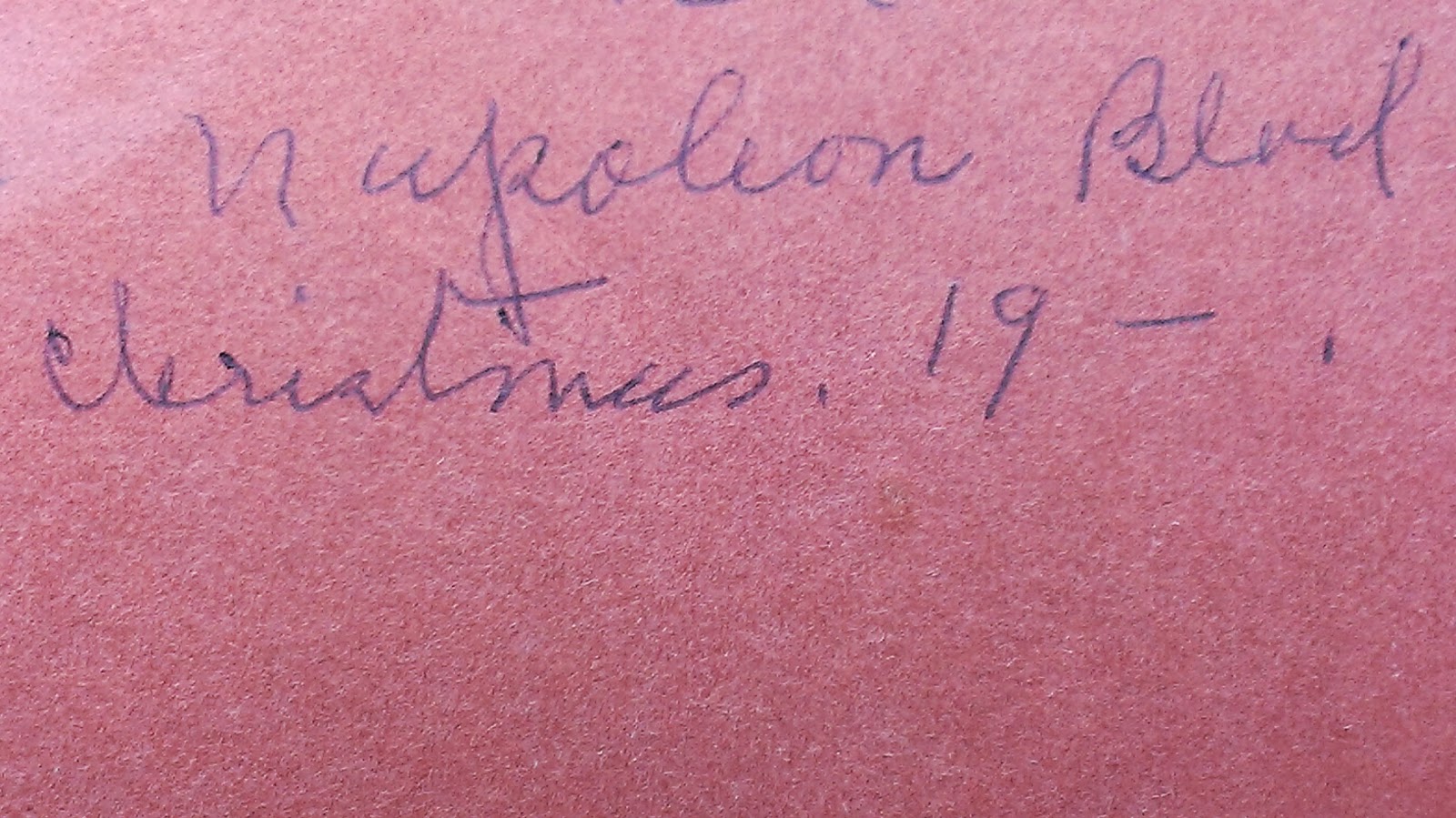

My grandfather wrote his name in pencil on the inside cover. Underneath that, in pen, my grandmother had written his full name, their address, and noted Christmas, 19--. I wonder why she didn't know the year that it was given as a gift? Perhaps she wrote this entry after my grandfather died and couldn't remember the date but wanted to make note of the circumstances. 

Weighing in at 1276 pages, this is a hefty book of words. It contains 1800 illustrations, a listing of Colleges and Universities, a biographical dictionary, and a pronouncing gazetteer. So in case you should ever want to untangle the pronunciation of Tsinling Shan, a mountain range in China, this is your book.

I love the dictionary's illustration of this little fellow.

There is a list of Common English Christian Names - both men's and women's. And who could do without the section on Foreign Words and Phrases including Proverbs, Colloquial Expressions, and the Mottoes of the States and Leading Nations. 

And here is something a bit outdated: a section titled Preparation of Copy for the Press advising that your "Manuscript should be kept and mailed flat. If necessary, it may be folded, but it should never by rolled." The editors have kindly included an explanation of proofreading marks and have used them to correct a proof of Lincoln's Gettysburg Address.


Seven pages of New Words include definitions for air condition, jam session, newscaster, and televise. 

In the Preface, the dictionary user is told that Lowland Scottish terms, which formed a separate glossary in the previous edition of the Collegiate, have in this book been made an integral part of the general vocabulary. The selections of these terms, based on their use by such authors as Burns and Scott, has been made under the supervision of the Editor in Chief.

Remember, this was back in the day when Robert Burns and Sir Walter Scott would have been household names. No need to identify them by first name!

I wrote about three other of the seven dictionaries that sit on my shelves here and here. Getting to know my word companions and writing about them is proving to be quite a nostalgic project.

Thank you, Mr. Webster.

Monday, September 30, 2013

Word Companions


I love an online dictionary. So handy when composing on the computer and I need to check a definition or find a synonym. And I am happy with the e-book feature, that with just a touch of my finger on an unknown word, displays its definition. 

But I am old school enough that I have seven English dictionaries on my bookshelves. They range in copyright date from 1906 to 1985. Four of the hardcover editions are thick books with the little thumbnail cut-in indexes identifying each letter. One is a "vest pocket dictionary for constant use" that belonged to my grandfather. Some of them are illustrated in black and white. One dictionary (copyright 1938) has pages of color illustrations that are spectacular - a mounted knight in full armor, insects of North America, and maps of the world. 

I was going to do just one post on all these treasures, but I got to looking through them and they are each so interesting that I will take my time, explore them, and write about them individually. 


I will start with the two that are paperbacks that I keep around for sentimental reasons. One is The New Merriam-Webster Pocket Dictionary (1971) that I bought new for 75 cents. That is the price on the cover! It claims to have over 45,000 vocabulary entries contained in it 692 pages. It also has a section of foreign words and phrases; a listing of the population of places in the United States and in Canada as of 1970; and, a list of abbreviations. 

There is a section titled New Words for a New Decade which includes, among others, seltzer, bamboo curtain, juicer, moon shot, and helipad.

I bought this dictionary to use in my first job as a journalist for a weekly newspaper in Pine Bluff, Arkansas. It is well-worn but the type is now too small for me to read. (Alas, aging eyes.) 

Last entry: zymase n : an enzyme or enzyme complex that promotes fermentation of simple sugars


The other paperback edition is The Merriam-Webster Dictionary (1974) which is based on Webster's Third New International Dictionary and Webster's New Collegiate Dictionary. The price on this one is $3.75. I bought it in the 1990s when I decided to become a freelance writer, but why I bought a dictionary with a 20-year-old copyright is curious. There are 57,000 entries in this edition. It has the same 1970 census figures and now includes a section of Signs and Symbols (including weather symbols and marks used in stamp collecting) and Pronunciation Symbols. It comes with helpful explanatory notes on how the entries are set up. It has 848 pages and the type is much clearer. 

Last entry: zymurgy n : chemistry dealing with fermentation processes

Noah Webster produced the first truly American dictionary in 1806. In 1828 he completed his two volume edition that had 70,000 entries, standard American spelling of some words, and included words such as skunk and hickory which were not in British dictionaries. In 1843 printers George and Charles Merriam bought the rights to Mr. Webster's 1841 edition of An American Dictionary of the English LanguageThe company's first paperback dictionary was published in 1947. 

The covers on both paperback dictionaries are bright red (though the first one is now a bit faded) and both at one time or another sat close by on my desk - their size and weight the perfect word companions.