Oh, dear. One little birthday and I am falling apart. I am rarely ill, I think the last time was two years ago, but yesterday The Cold and Cough Season has found its way into my world. Sigh. Cough. Sniffle. What to read when you are ill? I think about all I can manage today are a couple of short stories by P.G. Wodehouse, cups of peppermint tea, and naps.
I am not a big fan of fantasy novels so I have never read anything written by Terry Pratchett although I know that he is quite famous and popular and was knighted by The Queen a couple of years ago. That is why I was surprised to find in my hands the DVD Going Postal which is based on one of the many Discworld novels written by Sir Terry. It stars Brendon Coyle, David Suchet (Poirot) and Claire Foy (Little Dorrit). What intrigued me was that the two-part program concerns a conman who escapes hanging and is put in charge of reopening the post office in the city of Ankk-Morpork. Coming off my Month of Letters, in which I hand-wrote a letter or note everyday in February, I thought this might make for a fun viewing. Once I got past the whole dark steampunk atmosphere, I found the movie to be very entertaining. It all takes place in some other time and there are some great scenes of the interior of the derelict post office with its rooms and hallways and cubicles filled with undelivered mail. It seems that a different form of communication known as Clacks has been invented. It is based on the semaphore system of signaling and towers stretch across the region keeping the citizens of its cities connected. The evil fellow who owns the Clacks (well, actually, he stole the idea) doesn't care for competition from the post office and has had the last four postmasters killed. Now it is conman Moist von Lipwig's job to get everything put to rights again. There is a scene in which the idea of paper stamps is born (rather than hand-stamping each letter) and then the invention of 'perforation'. Apparently this is a great theme of the novels - that of introducing modern inventions into this fantasy world. I have only watched the first episode and I look forward to finishing it up this weekend. I was happy to see that there is a book Going Postal - I wasn't sure if the story was written just for broadcast - and I may just have to dive into the written weird world of Sir Terry Pratchett. Are you familiar with his works? If you are a fan, any comments?
Mais, oui! I so enjoyed reading Toujours Provence by Peter Mayle. This is the second book about his adventures leaving his home in England and moving to Provence. The first book, A Year in Provence, recounts his trials and tribulations in dealing with French workmen and building regulations as he tries to get his newly purchased home livable. In this book, the reader travels a little further afield as Mr. Mayle visits villages, restaurants, and markets in other towns in the region. There is even a visit to a dog show. It fascinates me to read how a person adapts to an entirely different culture, language, and ways of spending and keeping time. Here is what Mr. Mayle has to say about life after five years in Provence: The days pass slowly but the weeks rush by. We now measure the year in ways that have little to do with diaries and specific dates. There is the almond blossom in February, and a few weeks of pre-spring panic in the garden as we try to do the work we've been talking about doing all winter. Spring is a mixture of cherry blossom and a thousand weeds and the first guests of the year, hoping for subtropical weather and often getting nothing but rain and wind. Summer might start in April. It might start in May. We know it's arrived when Bernard calls to help us uncover and clean the pool. Poppies in June, drought in July, storms in August. The vines begin to turn rusty, the hunters come out of their summer hibernation, the grapes have been picked and the water in the pool nips more and more fiercely until it becomes too cold for anything more than a masochistic plunge in the middle of the day. It must be the end of October. Winter is filled with good resolutions, and some of them are actually achieved. A dead tree is cut down, a wall is built, the old steel garden chairs are repainted, and whenever there is time to spare we take up the dictionary and resume our struggle with the French language. And of course, to accompany the changing seasons there are many glasses of wine, pastis, and dinners with friends that last for hours. Not a bad way to live.
For the past couple of weeks the papers presented at a club I belong to, The Monday Afternoon Club, have had the common category of Literary Movements. The purpose of the club, founded in 1887, is "the encouragement of culture among women." Under the Literary Movements category members have given papers on writers of the Southern Agrarians (of which Robert Penn Warren was one); a literary history of New Orleans; and, poets of the Harlem Renaissance (Langston Hughes and Countee Cullen). Yesterday, the presentation concerned three Kentucky women writers: Caroline Gordon, Harriette Arnow, and Bobbie Ann Mason.
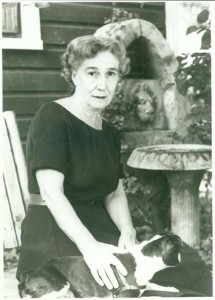
Caroline Gordon
Most Informative: Caroline Gordon (1895-1981) lived in Western Kentucky and was an award-winning writer and renowned hostess who entertained such luminaries as Robert Penn Warren, William Faulkner, Ernest Hemingway, and Ford Maddox Ford. Maxwell Perkins was her editor. She was married (twice) to Allen Tate, one of the Southern Agrarian poets. Her novel Penhally (1931) painted a portrait of the eponymous plantation, the family life, manners, and folkways of the Southern upper-middle class. In Women on the Porch (1944) she wrote about the way of life for Southern women including 'the help.' I had not heard of Ms. Gordon before but the two books mentioned (she wrote fifteen) sound fascinating.
Harriette Arnow
Most Touching: Harriette Arnow's The Dollmaker (1954), is the story of Gertie Nevels, a woman from the Kentucky hills who, with her five children, follows her husband to Detroit after he finds work in a factory during World War II. The book was made into a television movie in 1984 starring Jane Fonda who won an Emmy for her performance as Gertie. Ms. Arnow was born in southern Kentucky in 1908. She attended Berea College for two years and then transferred to the University of Louisville. She worked as a teacher and for the Federal Writer's Project of the WPA. She died on her farm in Michigan in 1986.
Bobbie Ann Mason
Most Entertaining: Bobbie Ann Mason (born 1940) grew up on her family's dairy farm in Western Kentucky. She majored in English at the University of Kentucky and moved to New York where she wrote for magazines about teen stars of the sixties. She is known for her novels and short stories including In Country (1985), Shiloh and Other Stories (1982), and pieces in The New Yorker and on the op-ed page of The New York Times. I met Ms. Mason at the Kentucky Book Fair last November and had her sign a copy of her biography of Elvis Presley (which I have started and to my chagrin have still not finished). So there you have it. A very enjoyable program about three of Kentucky's writers. And, a few more books for my TBR list.
This is how Donald Westlake describes one of the characters in The Fugitive Pigeon (1965):
Up till then I'd assumed the "Gross" was the man's name, but it was his description. He looked like something that had finally come up out of its cave because it had eaten the last of the phosphorescent little fish in the cold pool at the bottom of the cavern. He looked like something that better keep moving because if it stood still someone would drag it out back and bury it. He looked like a big white sponge with various diseases at work on the inside. He looked like something that couldn't get you if you held a crucifix up in front of you. He looked like the big fat soft white something you might find under a tomato plant leaf on a rainy day with a chill in the air. Mr. Gross is one of the members of the 'organization' that is out to get Charlie Poole. Because of a misunderstanding, Mr. Gross believes that Charlie, a rather aimless young man who works as bartender in his Uncle Al's bar, is a police informant. Two big guys with guns, Trask and Slade, come in their big black car to take Charlie away. He escapes and spends the next three days on the run trying to find out why these guys are out to get him. He works his way up a chain of gangsters (including his Uncle Al) attempting to determine why he is on the organization's Kill List. The action takes Charlie from Queens to Brooklyn to Greenwich Village to Long Island and back again. Sometimes he is chasing around in a black Packard driven by the part-time girlfriend of his school buddy Artie. Sometimes he rides the subway. Sometimes he has to resort to walking on foot. Whatever Charlie is doing, Mr. Westlake makes the action funny and outrageous. It all turns out well for Charlie in the end. Not only does he prove his innocence and get his life back, he gets the girl.