Friday, May 13, 2016

The 40s: The Story of A Decade from The New Yorker


A generous friend brought me a book the other day. As you can imagine, I rarely turn down the gift of a book. It was one he wanted to pass on and thought I would like.

Oh, yes.

The book contains a collection of fine pieces from that illustrious magazine The New Yorker and is entitled The 40s: The Story of a Decade.

And what a decade it was. During the first half the world was at war and the second half was spent beginning recovery from that war.

I whooped out loud with glee when I opened the book to the Table of Contents. Oh, the riches. Here are pieces written during WWII by E.B. White, A.J. Liebling, along with John Hersey’s profile on the then Lieutenant John F. Kennedy.

There are post-war pieces by Edmund Wilson, Lillian Ross, and Rebecca West’s report on the Nuremberg trials.

And, oh, the section of Character Studies: Walt Disney, Edith Piaf, Duke Ellington, Albert Einstein, and Eleanor Roosevelt.

Of course I read the book section first. Clifton Fadiman muses on Ernest Hemingway’s latest offering For Whom the Bell Tolls (he finds it to be a much deeper book than The Sun Also Rises), and Lionel Trilling gets a glimpse of the future in George Orwell’s Nineteen Eighty-Four, a book he found to be “profound, terrifying, and wholly fascinating.” It is compelling to read these reviews written so soon after the now-famous books were just hitting the market.

There is also commentary on film, theatre, art and architecture, musical events, and fashion.

And of course it wouldn’t be The New Yorker without poetry - verses by William Carlos Williams, W.H. Auden, and Elizabeth Bishop - and fiction - Carson McCullers, John Cheever, and the first publication of Shirley Jackson’s The Lottery.

Irresistible! You can see why I am excited to have this book at hand. History combined with stellar writing. So much more convenient - even at almost 700 pages - than a mile-high pile of ten years’ worth of magazines.

It is one I will dip into slowly and savor every word.

P.S I am quite a fan of The New Yorker, especially its early years. You can read three of my previous posts on the writers from that era here, here, and here.

Friday, May 6, 2016

Aunt Dimity's Death by Nancy Atherton


Image result for aunt dimity's death

As John Cleese of Monty Python's Flying Circus used to say, “And now for something completely different.”

As a change from the Nordic Noir novels featuring police detective Martin Beck by Maj Sjöwall and Per Wahlöö and the Gothic goings on in Jane Eyre, I am now reading a gentle mystery: Aunt Dimity's Death by Nancy Atherton.

Here we have the story of Lori Shepherd who is grieving the death of her mother. She is surprised to discover that the bedtime stories her mother told her concerning the adventures of an Aunt Dimity were actually based on the exploits of a very real Dimity Westwood.

Upon learning that Aunt Dimity was a real person and then sadly of her death, Lori’s own adventures begin.

It turns out that Lori's mother (American) and Dimity Westwood (British) met and became fast friends in London during World War II. Lori’s mother moved back to America after the war yet she and Dimity kept up a 40-year correspondence. It was these letters from Dimity that birthed the bedtime stories.

Without going into too much of the plot, I can tell you that Lori’s experiences include being befriended by members of an old world law firm, taking up temporary residence in a cottage (perhaps haunted) in the Cotswolds, feasting on oatmeal cookies (recipe included), having tea with the elderly Pym sisters, and staying in a suite at a luxurious and historic London hotel.

Oh, and perhaps finding a little romance.

I am only halfway through this 200-page novel and am thoroughly enjoying the author’s lighthearted and descriptive prose. The Mystery revolves around the meaning of a tattered, black-and-white photograph of a misshapen tree and missing photo album pages. So far there haven't been any bloody bodies.

That's a relief!

This book, published in 1992, is the first in a series of now twenty-one Aunt Dimity mysteries. It appears that my library has them all in its ebook collection.

It is a pleasure to be in Aunt Dimity’s world, an “oasis of charm and dignity.” Sometimes that is just where I need to be.

Saturday, April 30, 2016

The Abundance by Annie Dillard


I don't know why I have not written about Annie Dillard before. She is one of my favorite authors. As I look at my bookshelf, I can see right away three of her books leaning casually against one another: Teaching a Stone to Talk, An American Childhood, and Pilgrim at Tinker Creek.

I can never look at a tiny spider weaving its web in the corner of my bathroom without thinking of Ms. Dillard's story of living in harmony with a spider that had taken up residence in a corner of her cabin at Tinker Creek.

It has been a long time since I have dipped into any of her books - much to my loss.  If you have not read anything by Ms. Dillard you now have a chance to read examples of her wide range of intellect and interests. The Abundance, a collection of her essays new and old, was published last month.

There are four selections from Teaching a Stone to Talk, eight from An American Childhood, and two from Pilgrim at Tinker Creek. But I dove in right away to her essays from sources that I had not read.

Encounters With Chinese Writers is based on her experiences as part of a delegation of American writers who visited China and also hosted Chinese writers in America. The essay from that book is the story of a trip with the Chinese visitors to Disneyland. You can just imagine the culture clash!

Reading this narrative reminded me that there was a time when I lived not too far from Disneyland and I would sometimes go to the park after dinner. Merely an evening's entertainment for me. I was often struck by the fact that some families had saved for a long time to afford the trip to Disneyland and here I could just drive over after dessert.

The text of the short commentary Tsunami that she recorded for NPR is also included. It is her attempt to come to terms with the devastation that in one day, twenty-five years ago on April 29,1991, a tsunami took the lives of 138,000 people in Bangladesh. Her reading of the essay is online and you can listen to it here.

And there are others.

The Abundance is a wonderful collection of Ms. Dillard’s thoughtful prose. I am sure reading these essays will send you in search of the books whence they came. I can tell you that the three that I own are now down off the shelf and next to my reading chair. I will be revisiting them soon.

###

P.S. The preface to The Abundance is written by British author Geoff Dyer who will be speaking at the library here in May. You can be sure the date is circled on my calendar.

P.P.S. Let there be cake! Today, April 30, is Annie Dillard’s 71st birthday .

Friday, April 22, 2016

In Which I Finally Read Jane Eyre


I may be the last person in the world to read Jane Eyre. And, as it turns out, I am getting paid to do so.

Here's the story on that. A few months ago I wrote about attending a talk by Deborah Lutz on Victorian mourning jewelry and death relics (here). She is the author of The Brontë Cabinet: Three Lives in Nine Objects, a look at the lives of the Brontë sisters - Charlotte, Emily, and Anne - through the objects that were meaningful to them. It was short-listed for the 2016 PEN/Jacqueline Bograd Weld Award for Biography.


After the talk I introduced myself. She only recently moved to my fair city to become professor of English at the University of Louisville. As it turns out, Ms. Lutz is also the editor of the
soon to be published fourth edition of the Norton Critical Edition of Jane Eyre. We made a date to meet for coffee and as I sipped my espresso I admitted to her that I had never read Jane Eyre.

Gasp.

The next day she contacted me and asked if perhaps I would proofread the latest (and she hoped final version) of the manuscript for the Norton edition. She could pay me a small stipend. "Since you have never read the book, you would certainly bring fresh eyes to the text," she assured me.

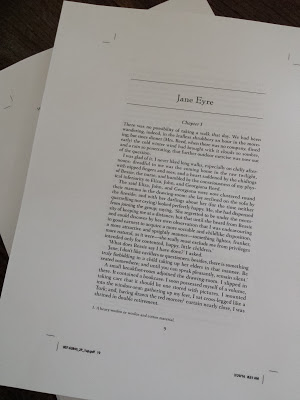
And so dear reader, that is why now I am assiduously reading the life and times of Miss Jane. I am on deadline, of course. The manuscript is printed out on standard copy paper with the actual text centered and justified. The print is small. There are footnotes. I have scheduled myself two hours a day to read its 400 pages which will put me just in at the May 1 deadline.

I must admit Ms. Brontë has an engaging writing style and I am quite caught up in her tale. I will say that the punctuation is bizarre: she must have thought she was going to be paid by the colon and semicolon. Those little marks run rampant on the page! And to think she wrote the book with a dip pen. By candlelight. (You can see a copy of her handwritten manuscript on the British Library's website here: Jane Eyre.)

There has been much hullabaloo about Miss Charlotte this year. Yesterday, April 21, was her 200th birthday (a day she shared with Queen Elizabeth who turned 90).

I have a feeling that reading JE will send me off on a Bold Brontë Adventure and I will be researching and reading more about Miss Charlotte and her sisters.

A worthy enterprise indeed.

Friday, April 15, 2016

The Road to Little Dribbling by Bill Bryson


Here's the thing about reading Bill Bryson's The Road to Little Dribbling: I was not only treated to a travelogue of his wanderings from the southern coast of England to the tip-top of Scotland with a little side trip through Wales, but also learned interesting tidbits about people I may never have heard of but in some way played an important part in British history.  

Perhaps best of all I get to laugh out loud at his all-too-spot-on rants about the ways of the modern world.

In The Road to Little Dribbling Mr. Bryson pays homage to his book about an earlier walking tour of England, Notes from a Small Island published in 1995, only this time he does more traveling by rental car and public transportation. He revisits some of his stopovers in Notes and finds himself in new places as well.

His journey takes him from the seaside town of Bognor Regis to the rugged Cape Wrath in the Scottish Highlands, with many stops in between.

Once again, I had to have a map handy to follow along as I did when I read Notes (which I wrote about here and here).

In a way it is a melancholy trip as he witnesses more and more change to the countryside and the towns. He bemoans the practice of tearing down perfectly serviceable buildings in urban centers to erect ugly creations of concrete and glass. And the towns that remain true to their architectural and historic heritage are so jam-packed with tourists and traffic that visiting there is quite the ordeal.

I am always happy to be in Mr. Bryson's company. If you have read anything by him, you know what a delightful experience his books can be. If you haven't read Notes from a Small Island I might suggest you read it first and then follow up with The Road to Little Dribbling.

Spoiler alert: There isn't really a town named Little Dribbling which is a shame. I was looking forward to arriving there, but, alas.

Friday, April 8, 2016

Road Trip, Anyone?

keep-calm-and-go-on-a-road-trip-1


Currently I am On the Road to Little Dribbling with Bill Bryson. Well, actually I am reading his latest book about his own trip to Little Dribbling via a whole multitude of English towns, villages, gardens, beaches, pubs, tea shops, and walking paths. I hope to be finished with this splendid journey in time to write about it next week.

In the meantime, here is your chance to take a little road trip of your own. Below are links to a series of Interviews with Bookstores that I discovered on the Guardian. They come by way of Literary Hub which is a part of the Guardian Books Network.  (I hope that is enough attribution...)

Each interview gives a brief history of the bookstore, Q&A with the owner, and staff recommendations. Get out your To Be Read list and enjoy.


Friday, April 1, 2016

The Art of Whimsical Lettering by Joanne Sharpe


Image result for the art of whimsical lettering

What I have found that I really like to do is take art classes, watch art tutorials online, and buy art supplies. That barely leaves any time for making art, but I do the best I can.

Over the past five years or so, I have taken multiple watercolor classes, had private art lessons, attended two visual journal workshops, dabbled in calligraphy, spent a weekend on a watercolor painting retreat, filled many sketchbooks, and generally had a splendid time doing all of that.

Because I am a writer, the idea of combining words and images strikes a creative chord with me. I tried calligraphy - even had a private lesson or two - but have to admit I don't have the patience for that type of formal lettering.  

So I was happy the day I was nosing around YouTube looking for a series of Strathmore Artist Papers tutorials and stumbled across short videos by Joanne Sharpe which in turn introduced me to her book The Art of Whimsical Lettering. 

I haven't actually put my hands on the physical book, but I do have it on order. In the meantime, I have watched every online tutorial of hers that I can find. And I took a peek online at several pages of the book.

Her whole point is to use your own handwriting and then font-it-up with the jazzy techniques. She loves color and doodles and is all about using your own print or cursive letters - or a combination of both - to add text to art and visual journals, day planners, art projects, greeting cards, canvases, and stationery.

This is her mantra: Play. Practice. Write. Repeat.

In the book she suggests starting a journal to practice and develop your own style. As if I needed any encouragement to begin another journal! She just uses an inexpensive composition notebook for hers. I am in luck as I have many of those around the house just waiting to be filled.

Also in the book, she lays out the materials she uses - pens, watercolors, markers - and again, lucky me, since I am such an art supply hoarder, I have most of them. And what I don't have, I just improvise.

I like her free-style doodles and borders and letters. It is the sort of casual art I like to create. Nothing too serious. Just a flourish or two here and there.

Her ideas may seem intuitive to some of you, but I not only need the print examples but also a visual demonstration. Hence her book and the videos. All of that helps. 

Below is a sample of a page I did using my own handwriting and mixing it up a bit with some ideas from Ms. Sharpe. It's pretty shaky, mainly because I don't know what I am doing, but you can see that a few of her techniques include thickening up the letters, adding color, and putting down shadows. 

I chose the word holiday because it contains letters that go above and below the line along with round and vertical letters. Ms. Sharpe encourages practicing writing words and not just copying an alphabet. That helps put one's own personality into the letters.


Now is my chance to begin my very own Whimsical Lettering journal and play with my stash of art supplies.