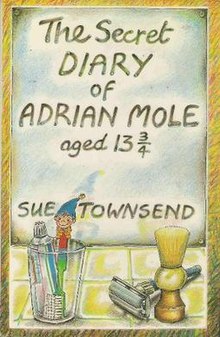
After writing a few weeks ago about the hilarious diaries of Adrian Mole, aged 13 3/4, I was reminded by Kathy at Catching Happiness of another diary keeper - Bridget Jones. This humorous work by Helen Fielding is one that I missed in the '90s although I did see the movie. I mean really, who could resist a film featuring both Colin Firth and Hugh Grant? Not me.
My library had a copy in ebook form and I was able to download it quickly. It begins, as does Adrian Mole's year, with a list of New Year's resolutions. Bridget's intents focus on not drinking, losing weight, quitting smoking, and not buying lottery tickets. She doesn't have much success.
Bridget is a 30-something single woman living in London who works for a publishing company. She has a heavy crush on her boss Daniel (a sleaze) which eventually turns into an unsatisfying relationship. There is the enigmatic Mark Darcy lurking in the background as well.
The thing is, and maybe it's just my age, but for all the book's humor, Bridget's self-loathing, her focus on weight (she records her weight at the beginning of every entry), and a proclivity for breaking her promises to herself begin to wear thin. Of course, I have all sorts of journals from my younger days filled with the same railings against my fate. Perhaps that's why it feels a bit uncomfortable to read Bridget's angst-filled pages.
The conversations with her female friends about men and their wicked ways are pretty funny. And her mother, who has recently left Bridget's father, now has a new lover and a new career. She flits in and out of Bridget's life and is not exactly a stable role model for her daughter.
I'd like to go back and watch the film again. I think perhaps Bridget and her trials and tribulations come across better on screen. And then of course, there are Colin and Hugh to admire.
I just finished another book that also looks at life from a woman's point of view: Heating & Cooling by Beth Ann Fennelly. This small book runs for only 107 pages and is made up of 52 micro-memoirs — many are only one or two sentences long while others are more fleshed out essays. They are at once humorous, wistful, and sometimes heartbreaking.
One essay recounts how one of her neighbor's exotic hens escaped and took up residence in Ms. Fennelly's yard and offered up an egg a day as rent. Another recalls, at age 8, how she and her father and sister slogged (thanks to the blizzard of '79) through the deep snow to church only to find the doors locked and Sunday Mass cancelled. Then there is the two-sentence report on the contents of a friend's freezer: a bottle of vodka and a dead cat in plastic wrap.
You'll just have to read the book to find out about that cat.
Ms. Fennelly teaches in the MFA program at the University of Mississippi in Oxford and is the state's poet laureate. That should give you an idea of the quality of writing here. There is not a dull verb anywhere. This is one to read again.
I love a book like this — brief memories captured and recorded. It reminded me of the late Amy Krouse Rosenthal's Encylopedia of an Ordinary Life (here). One of my favorites and another one to be savored.
What's new in your reading pile?
And you think you have problems?
Pity poor Adrian Mole. At the tender age of 13¾ he is struggling with his feuding parents, the school bully, the ungrateful family dog, insensitive teachers, a broken heart, and spots.
All of this and more is painstakingly, and hilariously, recorded in his daily diary entries. If you are a fan of a book in diary form, and I am, this one is for you.
I am having a ball reading it and find myself laughing out loud or snorting softly at his take on his predicaments. Oh, the angst.
Adrian is often baffled by the ways of the world. (Aren't we all?) His sincerity in reporting his daily dilemmas is quite touching. All he wants is to make sense of life's perplexities.
The Secret Diary of Adrian Mole, aged 13¾ by the English writer Sue Townsend has been on my TBR list for years. This first one was published in 1982 and there are seven in the series concluding with Adrian Mole, the Prostrate Years. It seems as if every British writer picks these diaries as their favorite funny book. Now, I can see why.
Here is a sampling of entries:
Saturday: I shall go mad through lack of sleep! My father has banned the dog from the house so it barked outside my window all night. Just my luck! My father shouted a swear-word at it. If he's not careful he will get done by the police for obscene language.
I think the spot is a boil. Just my luck to have it where everybody can see it. I pointed out to my mother that I hadn't had any vitamin C today. She said, 'Go and buy and orange, then'. This is typical.
Sunday: Now I know I am an intellectual. I saw Malcolm Muggeridge on the television last night, and I understood nearly every word. It all adds up. A bad home, poor diet, not liking punk. I think I will join the library and see what happens.
It is a pity there aren't any more intellectuals living round here.
Wednesday: ROYAL WEDDING DAY!!!!! (Charles and Diana)
How proud I am to be English! Foreigners must be as sick as pigs! We truly lead the world when it comes to pageantry. I must admit to having tears in my eyes when I saw all the cockneys who had stood since dawn, cheering heartily all the rich, well-dressed, famous people going by in carriages and Rolls-Royces.
Sunday: My mother has gone to a woman's workshop on assertiveness training. Men aren't allowed. I asked my father what 'assertiveness training' is. He said, 'God knows, but whatever it is, it's bad news for me'.
Well, this book is definitely not bad news for me. It is a delight and makes for perfect bedtime reading. What better way to end the day than with a laugh.
I have barely read any book reviews in the media this past year and all those lists being published right now about the Best Books of 2015 have left me cold. I have not added to a written To Be Read List. All year I have been overwhelmed with choice: the public library shelves, my own library, books on my Kindle, the library's ebook collection, used book sales...
The plan I have followed is that if a book shows up on my radar and piques my interest, and if I can get my hands on it, I read it. This is how I came to be reading The Folded Clock: A Diary by Heidi Julavits.
The title had me at Clock and Diary.
An image of a folded clock came to mind. It was the little travel clock that my father had. It was in a hard leather case that opened and revealed a clock face. The case and the clock formed its own freestanding triangle and would fit snugly on a bedside table. The clock had to be wound up with its little key on the back. It ticked. I loved it.
But this book is not about clocks, although it does concern time. It is, as the subtitle claims, a diary...of sorts. And I love reading diaries. Each dated entry - month and day only - begins with the word "Today..." The events take place over two years' time and they are not sorted chronologically. This actually makes for interesting reading. One minute the reader is in New York City on 9/11 and the next celebrating a Fourth of July holiday in Maine. A few pages later and there is the account of a dinner for academics attended by the author and her husband in Germany.
The accounts of the events in those two years are sometimes entertaining but sometimes her riffs spawned by the events are over-the-top neurotic. She seems to know a lot of people - other writers, film directors. She doesn't name drop but teases the reader with I-know-this-famous-person-but-I-am-not-going-to-tell-you-who-he/she-is. I found that annoying. Not because I don't want to miss out on celebrity gossip, but it seemed smug.
I have to tell you that although I am enjoying many of the stories that Ms. Julavits writes - her visit to E.B. White's grave; her attempts to read the French journals of the gossipy Goncourt brothers; her attendance at a party at Edith Wharton's house - I decided about a fourth of the way in that I didn't really like her.
I looked up her photo online thinking that might change my feelings toward her. It didn't.
I suppose that when reading someone's published diary, it is key to liking the diarist! Think E.M. Delafield (Diary of a Provincial Lady) or Virginia Woolf (A Writer's Diary).
I have been torn between wanting to let the book go because I don't care for the author or to continue reading it because some of the events that take place intrigue me.
The Folded Clock is on my Kindle as an ebook from the library and will expire in four more days. I guess I will let it.
Has this happened to you? You enjoy the book but wouldn't want to have coffee with the author? I would love to hear if you have had a similar experience.
The small cabinet over my refrigerator is full to the brim with those wonderful black-and-white school composition notebooks. They are the journals that I have been writing in for years. Interspersed with that lot are other spiral bound notebooks, a few 'pretty' journals, and even some loose-leaf pages kept from an ill-fated attempt to keep a diary using a three-ring binder.
I also have a drawer that holds journals that were started for a particular reason and abandoned - perhaps kept on a short trip or as the beginnings of a commonplace book.
All this leads me to Thomas Mallon's A Book of One's Own: People and Their Diaries. I first read it soon after its publication date in 1983. It is a book that I have been wanting to reread and finally got around to doing just that last month.
I had been sporadically keeping a journal for years before I first read this book - I still have two of the little diaries with locks from high school - but Mr. Mallon introduced me to people who were like-minded in wanting to keep a record of their days.
Here were writers, artists, preachers, politicians, crooks and even an assassin who felt compelled to make note of their thoughts, dreams, desires, and events happening not only in their private lives but in the world around them.
So we have samples from the famous diaries of Samuel Pepys, Virginia Woolf, Degas, Dorothy Wordsworth, and Thoreau. There are also entries from a whole raft of everyday people. Mr. Mallon has gathered all these keepers of the word into sections: Chroniclers, Travelers, Pilgrims, Creators, Apologists, Confessors, and Prisoners.
This is not a series of entries one after the other. Mr. Mallon entertains the reader with his own witty and insightful comments and connections on the entries and their compilers. This book helped me to expand my own journals into more than just whining about whatever particular inconvenience life was handing out at the moment. I found reading this book to be a fascinating look into the minds and lives of so many. Fascinating, even more so now, rereading it some decades later and after many hundreds of journal entries of my own.
My own journal keeping has developed, or maybe I should say declined, in the past few years to more of a nightly list begun as a way to remind me that I actually do accomplish some things each day. But I was inspired by one of the diarists in Mallon's book, Toni Bentley, a corps member of the New York City Ballet who kept a journal for one Winter Season begun on November 21, 1980 and finished on February 15, 1981. She used it to assess her career in dance and her commitment to her art.
So I hunted up this attractive journal that I had tucked away for a special occasion...
...and began keeping what I am calling A Winter Journal on November 1, 2014.
Of a late afternoon, I sit at my desk overlooking my small front yard and ponder and muse and write about whatever strikes my fancy. It may be a page describing the items on my desk, two pages bemoaning my fate at the mechanical problems my Jeep is experiencing (and have thankfully been repaired), or it may just be a list of cities I still want to visit.
I might also include observations on the weather, the light, the leaves piling up, or the red cardinal at rest on the rim of the French blue birdbath.
I write with a comfortable Lamay fountain pen that I purchased on a trip to Savannah a couple of years ago. (Fountain pens are my one weakness!) The pages are smooth and lined and the book has a nice heft to it so I know I mean business. I bought this one and a red one like it ages ago. I only paid $7 for each one. Now I wish I had bought a few more.
I realize this post has turned out to be more about me than A Book of One's Own, but I highly recommend Mr. Mallon's look at diaries and the people who keep them. It just might inspire you to pick up a notebook and begin to write.
Catherine, Called Birdy is a young adult story told in the form of a diary. Not so unusual, you might think, but Catherine is a 14-year-old girl writing about her life in the year 1290.
I discovered this book when it was first published in 1994 and recently came across it at a used book store and snatched it up to reread. It was as fun to read as I remembered.
Author Karen Cushman has created a spunky, clever, and fearless heroine in her tale of life in a large manor with its attendant village as seen through the eyes of Catherine, called Birdy.
Things were a lot different in the Middle Ages.
Without romanticizing conditions in the least, we learn that Catherine spends minutes picking fleas off her arms and legs; hours mending and hemming sheets and other household linens; days longing to be playing outside with her best friend Perkin, the goat boy; and weeks trying to foil her father's plans of marrying her off to the first wealthy suitor who happens to call.
As to the running of the household, we get to attend holiday feasts featuring eel pudding, herring pie, fried milk, turnip soup, figs stuffed with cinnamon, an onion and mustard omelette. Some days are filled with clearing the floors of debris and freshening the rushes that serve as a carpet with fragrant dried herbs such as lavender. Visitors to the manor all pile into the main hall and sleep wherever they can - sometimes even on the floor in Birdy's room which she already shares with the nursemaid Morwenna.
Birdy takes part in village fairs and celebrations; attends her first hanging which she discovers is not the gay affair she thought it would be; prepares tonics and salves for the ailing in the household; witnesses the funeral procession of Queen Eleanor, led by the handsome King Edward and his entourage; and longs to go on a crusade of her own.
She writes about her days and muses about life in her own funny way. Her diary entries are filled with saints, curses (Corpus Bones!), odd characters, and all sorts of hilarious and sometimes sad goings on.
A delightful tale. Although I surely wouldn't want to live in Catherine, called Birdy's time, I think I would surely enjoy having her as a friend.
I have been entertaining myself this morning by thumbing through an assortment of diaries looking to see if anything exciting happened on this day in the lives of anyone. One book entitled English Diaries (1930) and edited by Elizabeth D'Oyley contains the musings of such worthies as Samuel Pepys, John Evelyn, Fanny Burney, Dorothy Wordsworth, Sir Walter Scott, and arctic explorer Captain Robert Scott.
I couldn't find any entries for December 22 by any of the diarists in that collection, so I turned to The Assassin's Cloak (2000) edited by Irene and Alan Taylor. This is a wonderful compendium of diary entries by a wild variety of folks and is both entertaining and thought provoking.
Here is one of the five entries included for today written down by J.R. Ackerley, a British writer and editor. Mr. Ackerley (1896-1967) was the literary editor of The Listener, the BBC's weekly magazine. I must say I have to agree with his sentiments...
December 22, 1952
The Movietone News this week had a Christmas feature. A large number of flustered turkeys were driven towards the camera, and the commentator remarked that the Christmas rush was on, or words to that effect. Next they were seen crowded about their feeding trough, making the gobbling turkey fuss, and the commentator observed, with dry humour (again I do not remember his exact words), that it was no use their holding a protest meeting, for they were for it in the morning. Similar facetious jokes followed them wherever they went, hurrying and trampling about in their silly way; for to make them look as silly as possible was no doubt part of the joke and easy to achieve: turkeys, like hens, like all animals, are beautiful in themselves, and have even a kind of dignity when they are leading their own lives, but the fowls, in particular, look foolish when they are being frightened.
These jolly, lip-licking sallies, delivered in the rich, cultivated self-confident voice of one who has no sort of doubt of his own superiority to the animal kingdom, raised no laugh from the considerable audience, I was pleased to note. I took it from the silence that many other people besides myself would have been glad to be spared jeers and jibes at these creatures who, parting unwillingly with their lives, were to afford us pleasure at our Christmas tables.
...How arrogant people are in their behaviour to the domestic beasts at least. Indeed, yes, we feed upon them, and enjoy their flesh; but does that permit us to make fun of them before they die or after they are dead? If it were possible, without disordering one's whole life, to be a vegetarian, I would be one; nothing could have been more disgusting and degrading than the insensitiveness displayed by the exhibition I have described.