Thursday, November 28, 2013

In Which I Begin My Four-Day Retreat


I am taking advantage of this four-day Thanksgiving weekend to retreat from my everyday schedule. I am not going anywhere - just staying holed up at home - but taking a break from my computer screen, errands, smart phone, and email. I do have Thanksgiving dinner plans but after that the only company I will be keeping is my own. 

Some folks plan a Writing Retreat in which they take a few days off for solitary, uninterrupted time to work on a creative project. I am switching that up. As of today, I am on a No-Writing Retreat. 

Here are my simple rules:

Screen time - None. That means no blog entries, no checking email, no online reading, no mindless surfing, no phone calls. I am putting my laptop in the closet and turning off my phone. And no television. Oh, wait. I don't have one. Well, I won't be watching any movies on my laptop either.

Writing - The only writing I will do is by hand. That means I can catch up on handwritten correspondence, brainstorm some plans for 2014, continue with entries on my book card catalog, and perhaps do a bit of sketching. I am looking forward to having my fountain pen in my hand.

Reading - Oh my. I have so many books in my To Be Read pile that I don't really know where to start. Perhaps with At Home
(that seems appropriate) by Bill Bryson, Cross Creek by Marjorie Kinnan Rawlings, and As We Were by E.F. Benson. 

Domestic projects - There are a few projects here at home that I would like to work on before the end of the year - a bit of filing, decluttering, rearranging, etc. I also plan to take some time to sort and sift through books that I might be willing to send to another good home - donated or gifted away. (Perhaps this means a book giveaway or two from Belle, Book, and Candle. Stay tuned!)

In preparation for these four days, I have stocked up on food. I bought a new blend of herbal loose tea to sip on while I think. I have some yummy oatmeal/cranberry cookies from a local bakery to munch on. And I made a pot of vegetable-lentil soup that should last me a while and provide warmth and nutrition.

I don't plan on going anywhere in the car except to the park (five minutes away) where I walk every day. I kind of have a schedule in mind as to how I will spend each day but nothing written in stone. Let it unfold. Lots of naps. I want this time to be relaxing and quiet and not governed by a mighty To Do List.

So I will see you back here on Monday, December 2. I trust I will be rested, refreshed and refueled.

Wednesday, November 27, 2013

Making a Gratitude List

Here in the United States, tomorrow we will celebrate Thanksgiving. It is my favorite holiday. A quiet day to spend with friends and family. 

I am grateful everyday and don't really need a special holiday to remind me of the many treasures in my life. But I began a tradition long ago that I still practice. For years, I have begun Thanksgiving morning by getting up early, sitting quietly with a cup of coffee, and making an ABC gratitude list in my journal. I note the A-B-Cs down the side of the page and then quickly fill in with something that I am grateful for.

Apples, Baseball, Coffee, Dandelions

For instance, from last year's list, November 21, 2012:

Elvis, Friends, Goats

And, an oldie from almost 25 years ago, November 23, 1989:

Hope, Intuition, Joy, Kindness

If you love lists like I do, you've got to love making a gratitude list. I think the ABC list is carefree and casual and spontaneous. I simply write whatever pops into my mind and sometimes surprise myself.

Lemonade, Magic, Nightingales, Ohio River, Paris

You could also use the ABCs to guide your list to include only foods or animals or people. Or you could go for a list of totally non-material things.  One year I listed authors:

Quiller-Couch, Rhinehart, Simenon, Thirkell

Even a non-gratitude list will give you gratitude if you can just flip the list around.

For example, I may not be grateful for floods, plagues or pestilence, but I am grateful that I am not experiencing any of those right now. I may not be grateful for all the torn-up streets that plague the city right now – construction, utility company updates, repaving, bridges – but just think how grateful we will all be when eventually the streets are clear and smooth.

Umbrellas, Vegetables, Writing

It seems to me that having a grateful heart wards off resentment, envy, self-pity, and despair. Gratitude is the cornerstone of a spiritual life. And the only way I know to foster gratitude is to say “thank you” often.

Say '”thank you” out loud. Whisper it before falling asleep. Say it to your family and friends. Write it on your check to the electric company. Wave it to the stranger who lets you out in traffic. Write thank you every morning in your journal.

Buy a small notebook to keep by your bedside and every evening record those people, places, events, and things that you are grateful for. 

Take a few moments in the morning and start your day with gratitude. 

eXcellence, Yellow, Zinnias.

Happy Thanksgiving to all!

Tuesday, November 26, 2013

The Book Fool


Nicholas A. Basbanes is an author and former book review editor for The Sunday Telegram in Worcester, 
Massachusetts. He spoke with Brian Lamb in a 1995 interview on Booknotes about his book, A Gentle Madness: Bibliophiles, Bibliomanes, and the Eternal Passion for Books. The following quote comes from Booknotes: America's Finest Authors on Reading, Writing, and the Power of Ideas and explains the books title:

I coined the title myself, actually. It was a description made of Isaiah Thomas, a great nineteenth-century American bibliophile and collector. When he died, his grandson Benjamin Franklin Thomas, said, "Grandfather was afflicted from the earliest age with the gentlest of infirmities: He was a bibliomaniac." And when I saw that description of him, I said, "There's my title."

On the cover of the book, it is, in fact, a woodcut - a very famous one. It's 500 years old. It was executed by Albrecht Dürer. It's called The Book Fool and it was in Das Narrenschiff, the original Ship of Fools. And the first fool of the whole story, the fool at the helm, was the bibliomane, the book fool. And I've always loved that particular engraving, and I chose it for the dust jacket.

His title, A Gentle Madness, could be used to describe a condition that afflicts many of us. I have not read any of Mr. Basbanes' nine books that cover authors, libraries, and book-collectors. His latest is On Paper: The Everything of Its Two Thousand Year History, by a Self-Confirmed Bibliophiliac.

I best be updating my To Be Read list!

Are you acquainted with Mr. Basbanes and his bibliomania?

Monday, November 25, 2013

Brian Lamb and Booknotes

Brian Lamb

Back in the day when I owned a television set, Sunday evenings at eight o'clock would find me watching Booknotes, hosted by Brian Lamb on C-Span. 

I have a huge crush on Mr. Lamb. I could be president of his fan club. He introduced me to so many authors and non-fiction books from 1989 to 2004 when he spent an hour with one author, one book. He sat in his chair facing his guest. They were separated by a small coffee table. The backdrop was a black curtain. No distractions. 

He asked his succinct questions and then shut up. He let the interviewee talk and never interrupted or tried to prove how smart he was. (Although I think he is brilliant.) I knew, that unlike some other interviewers, he had actually Read the Book. 

When Mr. Lamb retired from Booknotes in 2004, he began a show called Q&A in which he interviews not only authors but other "interesting people," journalists, corporate leaders, film directors, editors, and, in 2005, President George W. Bush.  This program is shown on Sundays at 8 p.m. on C-Span.

I have two books that have been culled from Booknotes interviews: Stories from American History - Leading Historians on the Events That Shaped Our Country (2001) and American's Finest Authors on Reading, Writing, and the Power of Ideas (1997).

The first holds eighty diverse tales told by current historians including a look at, among others, The Cuban Missile Crisis (Donald Kagan), The Roosevelt Dynasty (Peter Collier), The Harlem Renaissance (Emily Bernard), and Modern Presidents' Mothers (Bonnie Angelo). 

In the second book, Mr. Lamb has compiled answers from his guests to such questions as "Where do you write?" "Do you use a computer?" "How did you research this?" "Why are these folks in your dedication?" He gets answers to these and other questions about the writing process from 120 authors including David McCullough, Thomas Friedman, Shelby Foote, Betty Friedan, bell hooks, William F. Buckley, Jr., and Margaret Thatcher.

In the introduction to each book, Mr. Lamb writes a bit of the behind the scenes look at Booknotes including the time 10,000 viewers sent self-addressed envelopes to C-Span for the giveaway of 500 brass bookmarks celebrating the program's fifth anniversary. 

All 10,000 of them got their bookmark, because, as he wrote, "How can you turn away friends?"

Mr. Lamb retired as founding CEO of C-Span last year, and he donated his entire library from the Booknotes program to George Mason University in Fairfax, Virginia. He still conducts the Q&A program interviews. The videos and the transcripts of the Booknotes interviews (here) and the Q&A interviews (here) are available online. 

Thank you, Mr. Lamb!

Sunday, November 24, 2013

The Power of Light


Light-Bulb

Winter came swooping in overnight and the temperature plunged to 20 degrees. It plans on staying there all day. So I found myself this morning settled in with a cup of coffee and a copy of Jean Hersey's book, The Shape of a Year. I have been faithfully reading this book - month by month - containing Ms. Hersey's observations of life in and around her Connecticut home and small farm. It was published in 1967. 

I was enjoying her comments on the colors and fragrances of November and how she put together a terrarium made of moss, tiny ferns and plants, and a bit of lichen-covered rock or bark picked up on a walk in the woods near her house. I was tempted to try my hand at making her recipe for herb bread. 

And then the lights went out. And the heat. 

It didn't take long for my house to become quite chilly. And it was just a bit too dim to continue reading. 

After about 45 minutes, power was restored.  Then it went off for another 20 minutes and then came back on. Finally, I picked up Ms. Hersey again and in a moment, this is what I was reading:

I am thankful for light -- all kinds, man-made and natural. How lovely is dawn light, starlight, sunlight on green grass, candlelight, house lights on stormy nights, or on any night, street lights, and firelight. And the first streaming sunlight after a week of gray days and showers.

There is the magic of shining car lights on wet pavements on rainy nights. The mysterious lights on bridges like necklaces of diamonds in the gloaming. One of my favorite lights is the yellow beam of our outside light that greets us from down the road when we have been away for the evening. 

Well, I couldn't agree more. And what a pleasant meditation to read after sitting in the gloomy morning waiting for electric light - and heat - to return.

Saturday, November 23, 2013

Webster's Collegiate Dictionary, Fifth Edition, 1947


This is the dictionary that we used when my grandparents and I played Scrabble. I was quite young and they were kind enough to let me look up words before I made a play. I still have their original Scrabble game with its real wood letter tiles. In the box are the scores recorded from some of those early games written in my grandfather's hand. As a civil engineer, he was the one good at math and we trusted his addition skills.

Webster's Collegiate Dictionary, Fifth Edition has a copyright date of 1947. The cover is dark brown with decorative embossing and the title is stamped in gold. The letters are thumb-indexed and a black-and-white portrait of Mr. Noah Webster graces page one. It was printed by H.G. Houghton and Company, Electrotypers, Printers, and Binders in Cambridge, Massachusetts. It is based on Webster's New International Dictionary, Second Edition, copyright 1934.


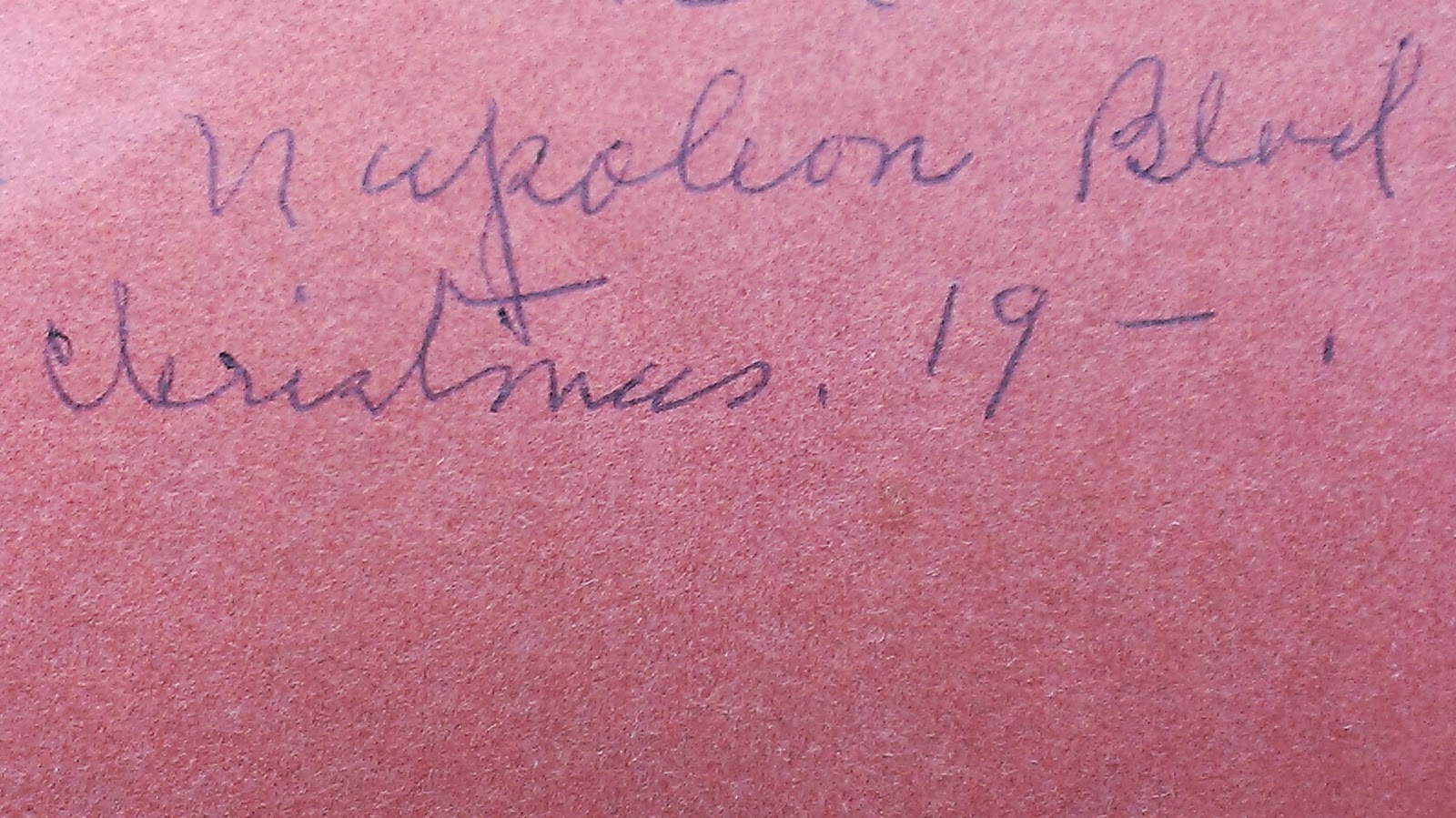
My grandfather wrote his name in pencil on the inside cover. Underneath that, in pen, my grandmother had written his full name, their address, and noted Christmas, 19--. I wonder why she didn't know the year that it was given as a gift? Perhaps she wrote this entry after my grandfather died and couldn't remember the date but wanted to make note of the circumstances. 

Weighing in at 1276 pages, this is a hefty book of words. It contains 1800 illustrations, a listing of Colleges and Universities, a biographical dictionary, and a pronouncing gazetteer. So in case you should ever want to untangle the pronunciation of Tsinling Shan, a mountain range in China, this is your book.

I love the dictionary's illustration of this little fellow.

There is a list of Common English Christian Names - both men's and women's. And who could do without the section on Foreign Words and Phrases including Proverbs, Colloquial Expressions, and the Mottoes of the States and Leading Nations. 

And here is something a bit outdated: a section titled Preparation of Copy for the Press advising that your "Manuscript should be kept and mailed flat. If necessary, it may be folded, but it should never by rolled." The editors have kindly included an explanation of proofreading marks and have used them to correct a proof of Lincoln's Gettysburg Address.


Seven pages of New Words include definitions for air condition, jam session, newscaster, and televise. 

In the Preface, the dictionary user is told that Lowland Scottish terms, which formed a separate glossary in the previous edition of the Collegiate, have in this book been made an integral part of the general vocabulary. The selections of these terms, based on their use by such authors as Burns and Scott, has been made under the supervision of the Editor in Chief.

Remember, this was back in the day when Robert Burns and Sir Walter Scott would have been household names. No need to identify them by first name!

I wrote about three other of the seven dictionaries that sit on my shelves here and here. Getting to know my word companions and writing about them is proving to be quite a nostalgic project.

Thank you, Mr. Webster.

Friday, November 22, 2013

James Tobin and Franklin Delano Roosevelt at the Library

Author James Tobin 

It's been a big week for books and author events. Last night, as part of its Author Lecture Series, James Tobin spoke at the public library about his new book The Man He Became: How FDR Defied Polio to Win the Presidency.

He began by telling that his interest in Franklin Delano Roosevelt (1882-1945) began when he was a child and his grandmother told him the story of Roosevelt's "act of great courage" as he struggled to walk across the stage at the Democratic National Convention in 1924. This public appearance came just three years after he was stricken with polio, at the age of 39, which left him permanently paralyzed from the waist down. He was never able to walk unaided again.

That night in New York, FDR was giving the party's nomination of Al Smith for president. Mr. Smith lost the national election, but Mr. Roosevelt went on to win the governorship of New York four years later. In 1933 he became the 32nd president of the United States and served an unprecedented four terms in the White House seeing Americans through the Great Depression and World War II. He died just a month before the war in Europe ended.

In his book, Mr. Tobin asserts that FDR's response to his polio transformed his character and strengthened his resolve to pursue his political career. That his rehabilitation showed him as a fighter and proved to people that a crippled man could be strong. He was not a man to pity but a man to cheer. 

Over the years, it has been reported that there was a great cover up of the president's disability. That the press didn't write about his health and photographers were forbidden to take pictures of him. This is not true, said Mr. Tobin. There was no conspiracy. The issue of his disability was discussed by him and others. His only objection to being photographed while walking or getting in or out of a car or boarding a train, was that he was worried about falling in front of an audience. And although he fell often in private, he didn't want people to think of him as a figure to be pitied. 

Mr. Tobin asserts that FDR's courage and determination to overcome his own personal ordeal is what gave the American people a reason to hope during the Great Depression and the war. 

The event was well-attended and as an added bonus, a crew from C-Span was there filming the presentation to be shown on BookTV at some future date.